Showing posts with label Dementia. Show all posts

Tuesday, September 14, 2010

String With No Kite

I have been waking up the past few nights in a cold sweat.

Mother has been visiting my dreams; she is young and beautiful again, exactly as I remember her from my childhood. She then moves toward me and stares directly into my eyes while painfully asserting,

“I wanted to go home and you wouldn’t let me.”

I don’t sleep following these dreams. Instead, I spend time trying to convince myself she is wrong; after all, I hadn’t actually had a say in the matter. But, I am painfully aware she has never liked being in the nursing home ~ at least when she was able to fully process and articulate such thoughts.

Eventually I convince myself she must, on some level, understand that making the fateful decision was extremely traumatic for every member of our family.

There simply was no choice.

This might seem incredible but, to my recollection, I don’t believe I have ever had a dream specifically involving Mother, especially odd given our intense experiences over the past two years and more. If there is any one factor that might explain her appearing to me in my sleep these past few days, it is likely because we have all been riding a non-stop roller coaster of emotions these past few days.

~~~~~~~~~~~~~~~~~~~~


Many have fallen prey recently to a particularly vicious respiratory bug that has been blazing a trail across the country. I can personally vouch for its sting. While not certain if I have ever had the flu, I am now convinced my experience with this unwelcomed intruder could not be far removed.

As with any outbreak, the elderly, who are particularly vulnerable to virulent assaults, have not been spared; many residents in Mother’s nursing home have suffered the full wrath of this virus. And while most are recovering slowly, a couple of these elderly residents have been recently felled.

Unfortunately, this is the scenario which has generated so much concern for Mother these past few days.

Rarely requiring even over-the-counter pain relievers, Mom suddenly began complaining of daily non-specific body aches late last week. Over the next couple of days, she then began to demonstrate some nominal upper airway congestion. No problem. We used the available drugs at our disposal so as to dry up the secretions and all seemed to be going well.

Until Sunday night.

Just as one of my brothers arrived from out of town, Mom began to sound as though she was awash in fluid within her lungs. Our sister, getting off of the phone after trying to speak with Mother, was horrified by what she had heard; the only words Sister could utter were, “She is drowning!"

This is a noise you never want to hear.

Yet another drug was ordered to further manage the secretions, Hospice was put on alert, and Mom very quickly withdrew further into her own private world.

No matter how long we have anticipated a dramatic decline in her condition, no matter how hard friends have worked to assuage our collective concerns, the oft-told axiom holds true ~ at least for me:

“You are never prepared.”

~~~~~~~~~~~~~~~~~~~~

“It’s just that when I go into that room, I am now left not knowing what to do. I can’t even tell if she even knows I am here!"
Even before the dread virus entered our lives, attempting to wrest Mother even further from our grasp, we had all been dealing with the reality of her worsening dementia.

Many a friend has done his/her best to convince all of us that we have been doing everything for Mother “just by being there for her!”

My mind understands this.

But, my heart can't.

Intellectually, I grasp what has been happening to Mother over time, but the only indelible image I have in my head is not the face of the elderly woman lying unresponsive in the nursing home bed but an idyllic image of the younger woman who raised all of us.

“Mother doesn’t know who I am. She is just lying there with her eyes closed or, worse, wide open with nothing but a vacant look on her face. This is the woman who was everything to me when I was a little boy. But, who am I to her now?”

I can’t adequately express just how hard it is to look on as someone you truly love ~ like this woman who actually still resembles our Mother ~ who has lost so much of what made her the person you knew.

A thousand thoughts keep swirling through my head.

Dad did it right. He drove home, went to bed after a great dinner with Mylla, Uncle Jim and Kathy, and never woke up.

While the aftermath of that experience proved incredibly painful, I am convinced it is a far worse fate watching as someone you love dies ever so slowly from a progressive degenerative disease compounded by the twisted effects of dementia.

Nature allows for this double jeopardy; suffering two deaths is a cruel fate.

“Relationships are made of a multitude of invisible things” such as memories, shared experiences, hopes and fears. But when a person slowly disappears with dementia, family members and friends are left alone. It has been likened to “holding a string with no kite.”

A person might work hard to sustain himself after these losses, but the “invisible stuff” that ultimately makes up valued relationships becomes lost forever.

Exactly like a splinter under your skin. Even unseen, that splinter is no less painful.

~~~~~~~~~~~~~~~~~~~~

As yet another sad attempt has been made by one unwelcome Hospice nurse to cavalierly declare Mother’s life to be at an end, I am here to reiterate my firm belief that we ~ none of us ~ has a say in the matter.

The virus will run its course but I suspect Mother and the hand of God will ultimately be the guardians of her fate; after all, no one can deny Mom has proven, time and time again, to have an amazingly resilient soul.

If asked, I would admit to being somewhat guilty of not wanting to let go. I would love to have the Mother I once knew back ~ more than you can possibly imagine. This is still the woman who signed my report cards. This is still the woman who sent me to school, fed and clothed, every day. This is the woman who made certain there was food on the table at night as well as orchestrating ridiculously memorable Thanksgiving, Birthday and holiday celebrations.

I do most certainly want her back.

But, of course I know the fantasy will never come to pass.

In the meantime, her family will do its level best to take comfort in all of the little things. If given another opportunity, I won’t bemoan the fact that Mother can no longer fully enjoy a favorite song as she was capable of doing even a month ago; instead, I will work hard to simply enjoy watching one of her toes move to the rhythm of a “Rhapsody on a Theme by Paganini.”

We are all committed to do whatever it takes to fill whatever is left of her life with happiness and joy.

And in the end, when she has made her final decision, I will honor her wishes by surrendering to the greatest act of love available to everyone … by letting her go.

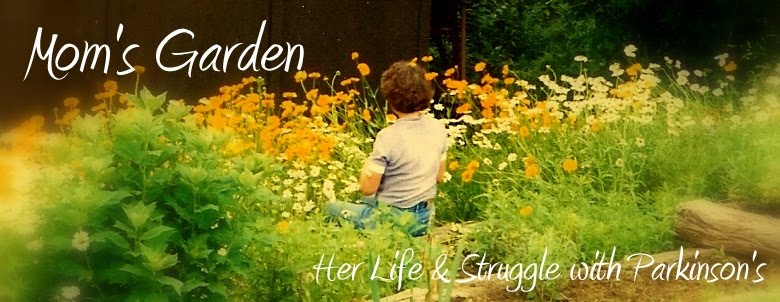
Maybe then, our eternally vibrant and beautiful young Mother will no longer haunt my dreams; perhaps, she will come and carry her youngest son on a walk to visit with her father in the middle of that beautiful field of flowers she has spoken of before.

I would surely welcome such a dream.

Time and time again.

Tuesday, August 18, 2009

Four O'Clock

ime has a habit of slipping away once we settle into routines. This “truism” seemed to fail us during those first few weeks following Mom’s move into the nursing home. From my perspective, these represent some of the most challenging days of my life.

Prior to the move, dementia had wrecked havoc on Mother’s sensibilities to the extent that she convinced herself she would be better off moving to her own apartment rather than remain in the comfort of her home. Even though the painful decision to transfer Mom’s care to GVM had already been made, her personal decision to move seemed to make the process easier for everyone.

I doubt anyone was more shocked than I by the apparent ease with which she adapted to her new surroundings. Mom seemed to accept nearly every aspect of her new life with nary a complaint. There was the sudden lack of personal privacy as well as the institutional process of managing almost every aspect of her life from taking medications to scheduling her showers and meals. Mother endured each new intrusion with grace.

At least, for a while.

A few weeks after arriving, a new diagnosis was added to Mother’s problem list: Sundowner’s Syndrome.

It is not uncommon to see patients who become irritable or confused as a result of unfamiliar hospital settings or following anesthesia. This “hospital psychosis” is a well-documented constellation of symptoms that occurs appreciably beginning in the late afternoon and early evening hours. While this psychosis can affect any age group, Sundowner’s Syndrome is generally limited to the elderly.

Also called, “sundowning,” it is most often associated with the early stages of dementia but can also be present in mood or sleep disorders. Sufferers experience periods of extreme agitation and confusion beginning late in the day which can be manifested in irritability towards caregivers and nursing home staff. While previously felt to be related to altered “circadian rhythm” cycles, current studies point to other causes such as drug-drug interactions and stress directly related to lower cognitive functioning.

One theory: the constant mental process of “normal” living can become overwhelming. These elderly individuals seem to have too much incoming information which may overload their already restricted cognitive functions. This results in periods of irritability and negative thoughts.

This process is not felt to be willful, per se. But, there is some conscious level of “frustration” due to awareness by the sufferers who realize they can no longer adequately process incoming information.

Come three or four in the afternoon, everyone began to gird ourselves for whatever might come.

On a good day you might find yourself walking in perpetual circles through the various halls; while it wasn’t the circumambulation of the Ka’aba during the Hajj, it may very well have been as exhausting. It was never a matter of slowly walking alongside your elderly Mother – you had to work hard just to keep up.

She moved as if on a mission. You never knew where she was headed but her forward movement had an element of intent. You would often have to take hold of her sweater or jacket to prevent forward momentum from propelling her upper body unsafely ahead of her center of gravity. There was no stopping her.

And then there were the bad days.

She would often be resting quietly then suddenly, with the sweep of a single moment in time, leap from her bed and declare her intention to “get the hell out of here.” Moving quickly and frenetically about the room, she would gather up any and all possessions in her path, bundling them for the trip home. You would have to follow her about the room in an attempt to prevent her from hurting herself in the process; as soon as you made any effort which she felt might be contrary to her intention, you were immediately, “persona non grata.”

Alternatively, she would leap from her bed and begin some chore which had, by this time, become very difficult for her to complete. Washing and setting her hair is one example. Once she had the idea in her head she was a woman possessed. There were some days when a caregiver would be allowed to help, but, more often than not, she would beg to be left, “the hell alone.”

One might ask what could be wrong with allowing her to wash and set her hair. In an ideal world, the answer would be "nothing." But, her “voluntary” movements had become erratic; these “dyskinetic” movements posed a potential hazard to her. She might be standing at the mirror combing her hair then suddenly and inexplicably hit her head against a wall. Normal activities of daily living had become dangerous.

There were many days when most everyone felt woefully inadequate helping her through these hours. These episodes were frightening and frustrating for everyone.

Time, the occasional use of some medication for agitation, patience, as well as her ever-advancing medical condition have all but rendered this phenomenon an element of her/our past.

When taking into account the research regarding sundowning, it makes me extremely sad realizing her irritability and negativity may have originated with some awareness of the ongoing failure of her mental processes. How incredibly cruel the insult if she was truly aware of the ongoing assault against her own mind?

And all of us were helpless as we stood witness to her manifested frustrations. It was excruciatingly painful realizing we were incapable of assuaging any anger, pain, and sorrow.

Sunday, July 5, 2009

Dementia

De-men-tia (di-men-shuh) - noun Psychiatry. Severe impairment or loss of intellectual capacity and personality integration, due to the loss of or damage to neurons in the brain.

Believe me when I write that Parkinson’s disease is a great offender. It makes victims of everyone it touches – patients and families, alike.

Studying Parkinson’s disease in medical school was basically a process. I learned what was required to pass my exams as well as gaining a baseline facility at recognizing the rudiments of diagnosis and treatment. It was assumed that I would probably not be required to know much more about the disease.

I could not have been more wrong.

In the years following her diagnosis, as we finally came to accept Parkinson’s as a permanent factor in Mom’s life, we were then asked to grapple with yet another unwelcome complication – the onset of dementia.

Technically, dementia is a condition which results in gradual loss of brain function; it presents with a decline in cognitive and intellectual function. In addition to memory loss, confusion, and problems with speech and understanding, dementia can also bring about changes in personality and behavior resulting in an increased reliance on others for daily activities.

It isn’t a disease so much as a constellation of symptoms which derives from a variety of causes.

Dementia only occurs in about 20% of Parkinson’s patients; in these patients, Parkinson’s disease Dementia (PDD) generally lags at least 10 to 15 years behind the original diagnosis of Parkinson’s.

Sure enough. As if on schedule, dementia gradually reared its ugly head in the tenth year or so following Mom's diagnosis.

Commonly voiced statement, “Oh, your Mother has OLDTIMERS!”

Once and for all: WRONG. Wrong on more than one level.

1. All dementia is NOT Alzheimer’s; conversely, all Alzheimer’s IS (a form of) dementia.

2. It is “ALZHEIMER’S,” not “OLDTIMERS.” (I wish I had a nickel .... )

Please understand that this attempt to describe dementia is not intended to be all encompassing; I am merely presenting an overview.

I have had a great deal of difficulty coming to terms with the fact that the Mother I know and love is slipping away in piecemeal fashion. The diminution of her physical and mental faculties in the last six months is staggering. A “good” day has now become relative; everyday has an element of “bad.”

This is our reality. For myself, I accept the facts, begrudgingly, but don’t ask me to like it.

Currently, Mom generally (and gratefully) seems to know who I am by sight when with her, but I have occasionally also been referred to as Billy, Mark, Jimmy, Ed, George, or, even Max – as in the dog.

I honestly do try very hard to find humor in moments like this -- without laughter I truly don’t know how I would survive.

When the laughter fades, however, there is generally a moment -- a pause followed by a “sigh” -- as I again remember that the laughter comes at an incalculable expense.

I miss the Mother I knew and love.

And, I also love the Mother who no longer fully knows me.